A short personal note before the piece.
I started writing this because of a feeling I keep hearing from senior designers I respect. Designers who are already fluent with AI, already shipping with the tools, but who are quietly noticing that the loud “Design Engineer is the new designer” story doesn’t quite fit what they’re seeing inside frontier AI firms. The shape underneath it is real. The vocabulary hasn’t caught up to it yet. When I dug into what’s actually shifting, the answer was clearer than I expected. Sharing it here.
If you read all the way through and any of it resonates, the project library at Product.ai has 30+ real problems we’re working on right now. Most of them don’t fit a single discipline’s lens. Some of them might be the work you’ve been waiting for someone to put in front of you.
Michael
What the data actually says
Sixteen frontier AI firms went through a forensic audit last quarter, scored against four structural-commitment markers for the Design Engineer role: a dedicated director, multiple roles in the function, published methodology, salary parity with software engineering. Only Vercel passed all four. Eight firms (Anthropic, Linear, Cursor, Replit, Resend, Conductor YC, Browser Company, Perplexity) had the role as a single-hire pattern, not a structural commitment. Three firms had no Design Engineer at all. Modal. Together AI. Figma.
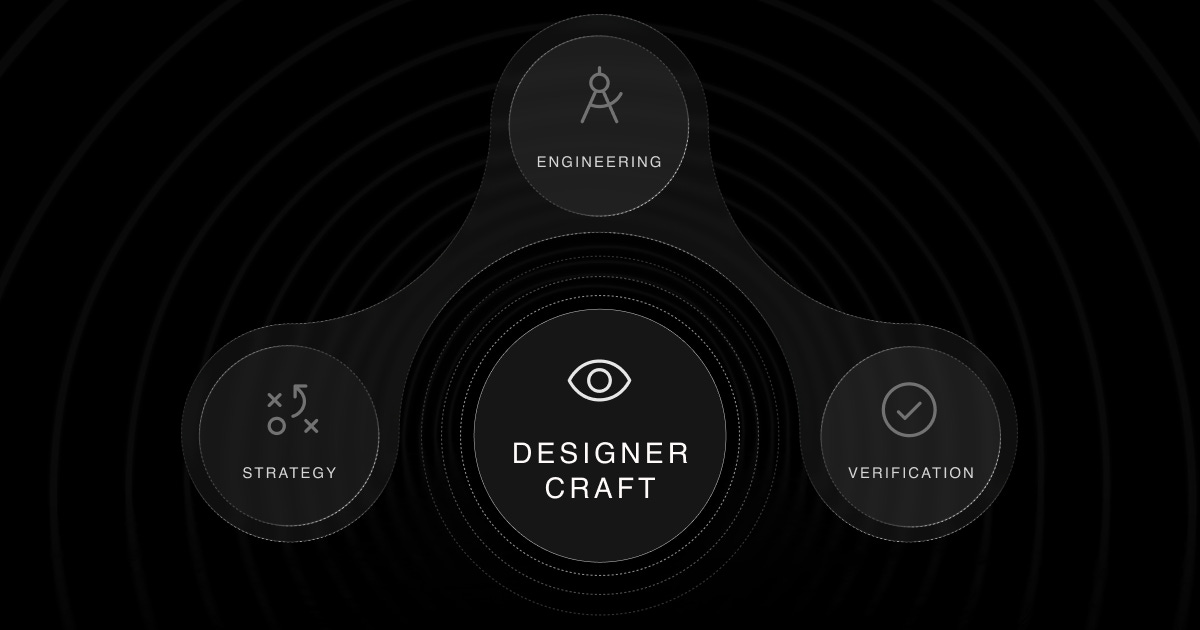
When industry pieces tell you “the Design Engineer is the new model at frontier firms,” they are pointing at one firm that did this on purpose, eight that did it once, and three that explicitly chose not to. That is not a model. That is one firm’s structural commitment, vendor-amplified by everyone wishing their company hired the same way.
Karpathy named the rate-limiter
At Sequoia AI Ascent in April, Andrej Karpathy crystallized a line he had been circulating for months: “You can outsource your thinking, but you cannot outsource your understanding.“
Karpathy was not talking about design. He was talking about the failure mode he sees in AI-leveraged operators. Someone uses AI to produce more without using AI to comprehend more. Efficiency without insight. Output without judgment. The shape of the work scales. The operator’s grasp of the system stays exactly where it was before AI showed up.
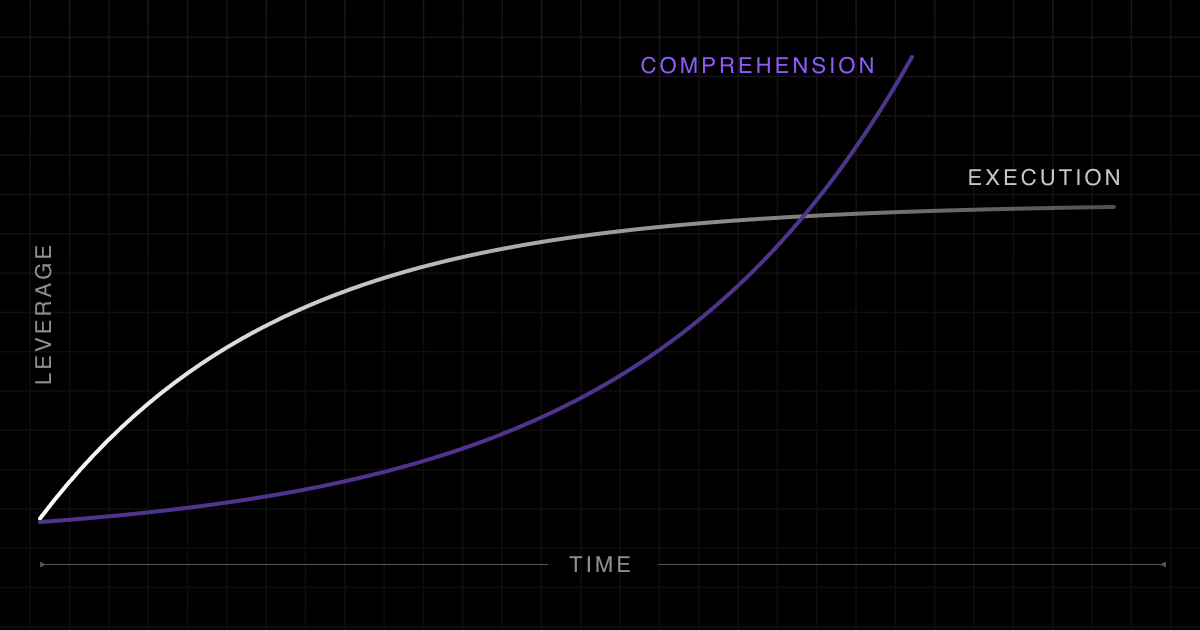
The line lands hard because it names a shift the entire knowledge economy is going through. AI absorbed the manual cognitive labor of execution. It did not absorb the meta-cognitive work of comprehension. The rate-limiter for the operator is not how fast they produce. It is how deeply they understand the system their production is shaping. Comprehension compounds. Execution does not.
When you take Karpathy’s frame and apply it to design, the Design Engineer story changes shape entirely. The consensus framing says: AI commoditized generation, so the work moved up to taste and orchestration. The Karpathy framing says: AI commoditized execution, so the freed bandwidth should go to deepening understanding of the whole system. The 10x designer of 2026 is not the one who can ship the most polished v0 prompt. The 10x designer is the one who uses freed cycles to become a better strategist, a better systems architect, a better detector of where the AI-generated output is wrong.
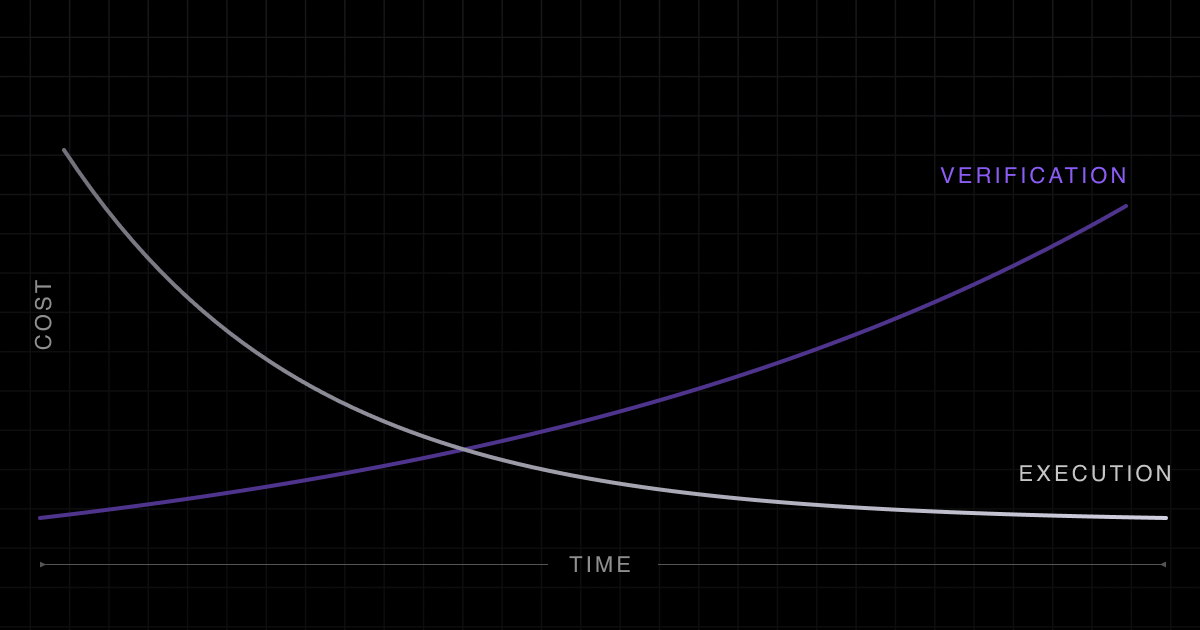
Generation cost collapsed; verification cost did not
This is the underlying physics. AI can produce ninety-nine percent visual fidelity in seconds. AI cannot tell you which of the ninety-nine percent is right. Design system hygiene, accessibility correctness, framing the right research question, calibrating taste against AI-generated wrongness, instrumenting whether users actually trust what they’re seeing: none of this got cheaper. Some of it got more expensive, because the volume of AI-generated artifacts that need verification went up, not down.
The data is starting to show the divergence. Figma’s 2025 AI Report found that seventy-eight percent of those surveyed feel more efficient with AI tools. Only thirty-two percent report higher trust in the resulting work. Efficiency is real. Trust is not following. The gap is the verification debt the AI accelerated.
Independent research is catching the same pattern. METR ran a controlled study of sixteen senior open-source developers. They reported feeling roughly twenty percent faster with AI tools. Measured against actual completion time, they were nineteen percent slower. Perception of speed is not the same as actual speed, especially for senior practitioners whose taste is detecting more wrongness in the AI output than the AI output is saving them in execution time.
Senior practitioners are already explicitly repositioning value above the assembly tier. Saarinen at Linear (”the hard part of design is rarely generating the form. It is understanding the problem well enough to know what and how something should exist at all.”). Andy Budd in his Feature Event Horizon piece. Joel Lewenstein at Config 2025 framing AI as a creative partner, not a creative replacement. Forrester. Smashing Magazine. NN/g. Five distinct surfaces, one coherent counter-narrative. The place AI most needs human judgment is exactly the place the consensus least often invests in.
What this looks like in practice
Three of the projects we are currently shipping at Product.ai operationalize this physics in different ways. They are public at product.ai/join/projects.
The Verification Confidence Indicator is a small UI primitive that closes the Trust Paradox. Across the AI-product industry, seventy-four percent of users rate trust four-or-five out of five, and ninety-three percent verify before they act. Stated trust is rhetorical. Behavioral trust is the only signal that matters. Three confidence states. Evidence trace one click away. Ships in production code, wired across chat, MCP, and extension surfaces. The designer for this project holds the model’s calibration semantics, the React component architecture, the design system’s token layer, three product surfaces’ interaction patterns, and the user-research framing of what “trustworthy” actually means in agentic commerce. Pure design won’t ship it. Pure engineering won’t ship it.
The Multi-Surface Trust Pattern Library defines how confidence, evidence, hedging, and “no answer found” each render across web, chat, MCP, and extension. The designer is holding four surface architectures in working memory and refusing the single-template fallacy that says one surface convention can be ported to the others. Multi-surface coherence is the new systems-design discipline.
The Behavioral Verification Dashboard replaces stated-trust surveys with behavioral signal. Citation-click rates. Return-after-recommendation rates. Override rates. Escalation rates. The mental model that produces this is the same mental model that produced Anthropic’s Claude Code postmortem in April. Three quality-degrading regressions passed every internal evaluation, every code review, every dogfooding pass. Users surfaced the degradation through /feedback, not through the eval suite. The discipline label says “designer.” The actual operating mode is none of the things “designer” is supposed to mean in 2026.
This pattern is not just design
Andy Budd wrote about this directly in March: “Founders become product managers, product managers become engineers, engineers become designers, and designers become PMs.” He was describing role-fluidity at companies where the AI leverage curve has hit. He was describing what happens when the cognitive bottleneck moves from execution to comprehension and the operators who can comprehend across domains absorb the work that used to live in separate functions.
Inside Product.ai, the same physics is operating across every senior craft. Our engineers are deep-deep in their core engineering and at the same time fluent enough in design that they can spar with a designer on usability and visual hierarchy. Our content people are not just content people. They are content plus AI engineering plus product. Our marketers are not just marketers. They are brand plus community plus growth engineering plus analytics. The discipline label names the center of gravity. The discipline label does not name the boundary of fluency.
Design shows up first and loudest because design has the most legible surface artifact. The live URL. The visible interface. The visual fidelity. The collapse is happening in every senior craft. Design is just where you can see it.
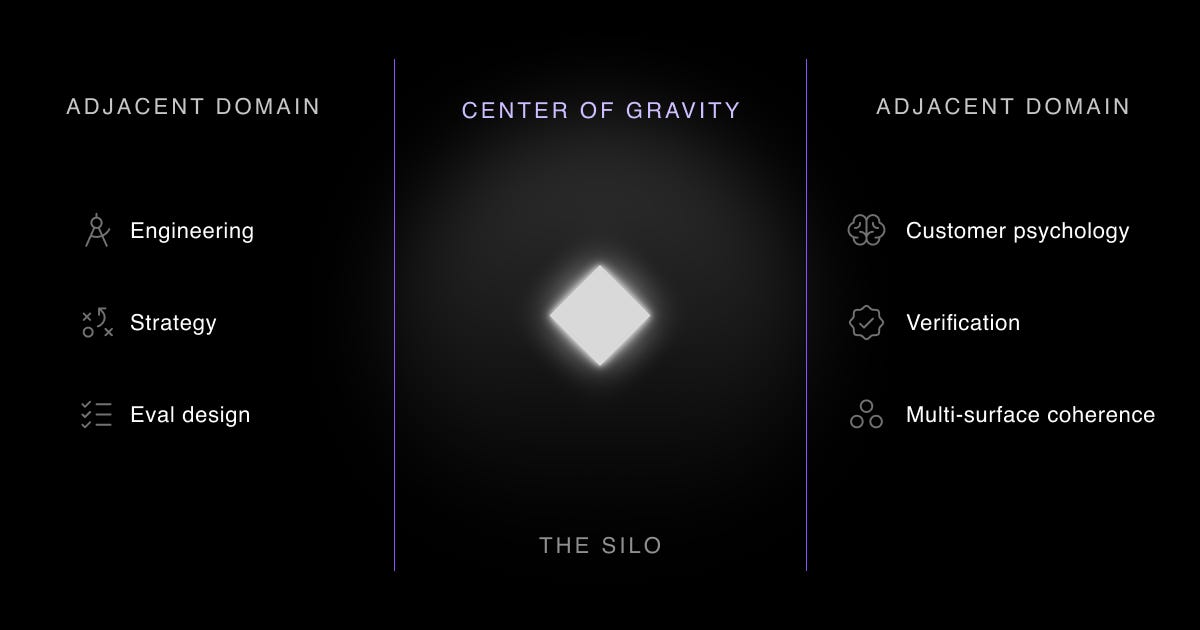
The negative case is more diagnostic than the positive case. The operator who fails in this environment is the silo. The narrow expert who makes decisions through one lens. They are usually good at their thing. Sometimes deeply, technically excellent at their thing. What they don’t do is think like a general builder. The silo is the failure archetype across every role we have hired for, not just design. Same shape every time. The label on the box is different.
What this means if you’re reading
Stop optimizing to become a Design Engineer. Or a Product Engineer. Or whatever the specific hybrid role your industry is currently naming. The hybrid label is downstream of a deeper shift. Optimizing for the label means you’ll be playing catch-up to the next label as soon as the consensus moves.
Optimize for the underlying capability instead. Build the comprehension. Use AI to free yourself from execution, not to produce more. Take the freed bandwidth and pour it into deepening your understanding of the whole system you operate inside, the adjacent systems you don’t currently work in, the strategic frame your craft serves. Ship things that span domains. Write about decisions, not process. Find the senior counter-narrative voices in your discipline and read them carefully. They are detecting what the dominant narrative is missing.
If your role’s job description does not fit the work you actually do, that is real. The vocabulary you’ve been missing is in this article. Deep generalism with a center of gravity. Comprehension as the rate-limiter. Calibration UI as the new locus of value. Multi-surface coherence. Behavioral verification. The silo as universal failure mode. None of these are concepts you needed to coin. Now you have the names.
We are operating this way at Product.ai because the math is correct, not because it is fashionable. If any of this resonates and you want to see what real work in this mode looks like, the public project library at product.ai/join/projects has 30+ real problems we are working on right now. Each one is a project an operator could shape with us. Some are design-led. Most are not. They are all problems that don’t fit a single discipline’s lens.
We are looking for the people who already know how to operate this way and have not yet found a place that operates as if this is the default.
Two requests if any of this landed.
First: tell me where I’m wrong. The Design Engineer consensus has a lot of smart people inside it, and they didn’t get there by accident. If there’s a structural argument for the consensus that I’m missing, I want to hear it. Reply to this email or comment on the Substack post and I’ll read every one.
Second: if the cramped feeling I described is one you’ve been having, the discipline page at Product.ai has the design state-of-practice we declassified plus the projects we’re working on. The broader project library covers every other senior craft. Both are open. The work is real.
More soon.
Michael