Disclosure. Karen Spinner designed and ran this study at Axioms.ai. Axioms.ai makes Product.ai, an AI shopping product that competes with AI shopping answers like those tested here, and runs SimplyCodes, a coupon site that earns most of the company’s revenue, so we have a commercial stake in how accurately AI tools report prices. That is why we publish every file needed for a stranger to check or rerun every number.
Download the data (.csv) · Download every file (.zip) · Browse it on GitHub
The full study, with its interactive figures, is on Axioms.ai, and the study plan is on Axioms.ai’s pre-registrations page.
Every raw API response, control browser read, coder verdict, decision on a coder disagreement, and script, plus the study plan. Start with tries.csv, one row for each of the 1,200 tries.
Study plan
Files: PREREG.md, LOCK.txt
Before the first counted run, we wrote the store list, product links, prompt, and grading rules into a study plan on November 3, 2026. This is an internal study. We did not register the plan with anyone, and it makes no prediction. It fixes the method, and we report what the method found. The study plan, each later change to it, and the file fingerprints are in the data repository (PREREG.md and LOCK.txt).
Collection and grading scripts
Files: stores.yaml, pilot.py, products.py, control.js, grade.py, code_fetch.py, final.py, results.py, capcheck.py
Frozen 21-store URL list, verbatim API prompts, 13-token robots.txt check, Chrome price extractor, deterministic cent grader, cross-lab coder harness, and RESULTS.json builder.
Daily raw logs and decisions
Files: runs/products-2026-11-{05,07,09}/, runs/pilot-2026-11-{05,07,09}/, FOOTNOTES.md
Every raw API JSON response, Chrome control read, blind coder verdict (coding.jsonl), decisions on coder disagreements (rulings.csv), Day 1 pre-amendment/ files, Nov 3 pilots run before the study began, and all 25 footnotes.
These notes go out with the raw files. Each one names the pages it covers and says how they were counted.
Tools
1. Perplexity’s Sonar answers from Perplexity’s search index, not from a live visit to the page. When it says it could not open a page, the reason can be that the page is not in its index (for example “page not found in search results”), not that the store turned it away. Its results are reported with OpenAI’s, apart from the two URL-reading tools. [Nov 5]
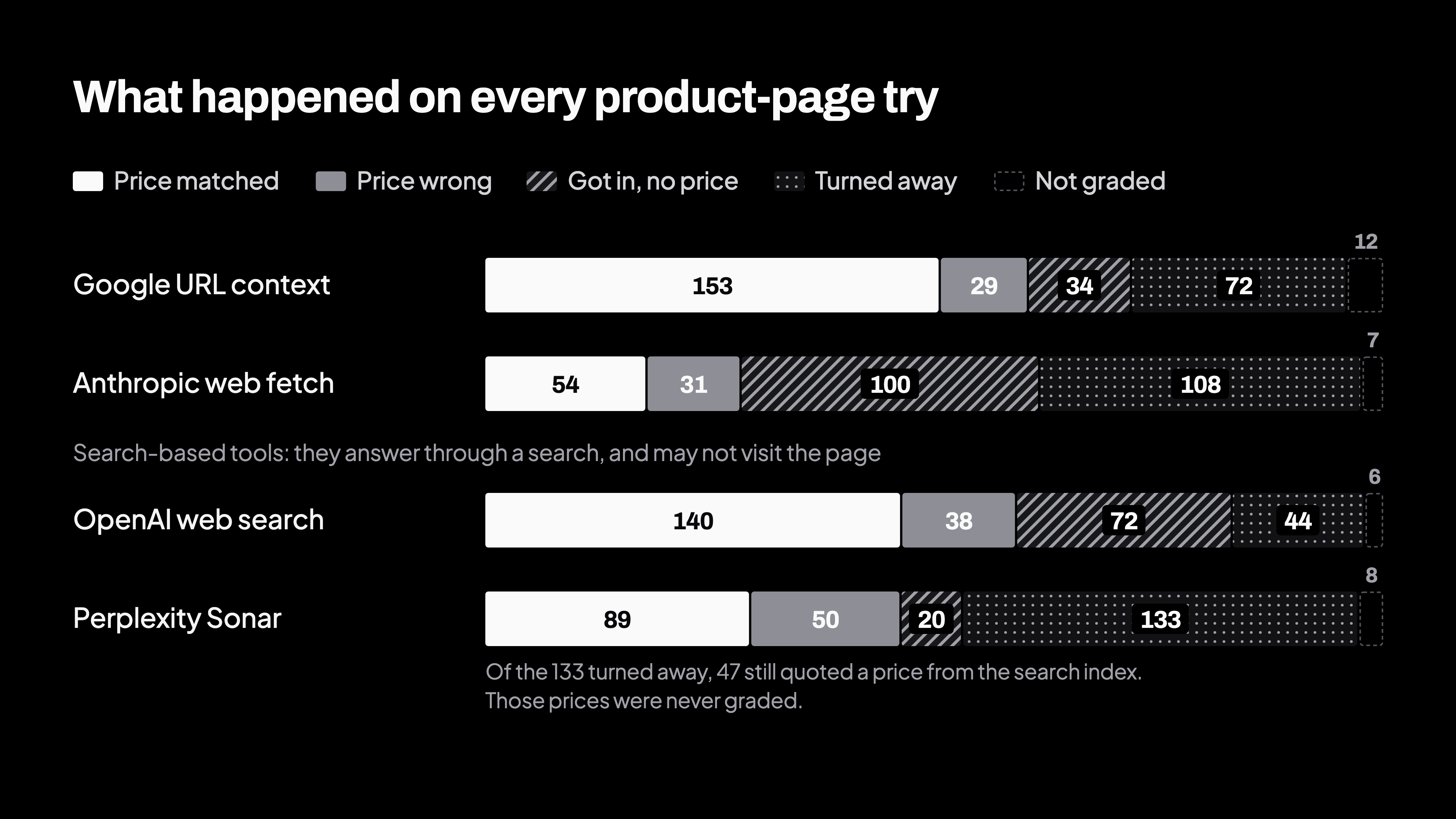
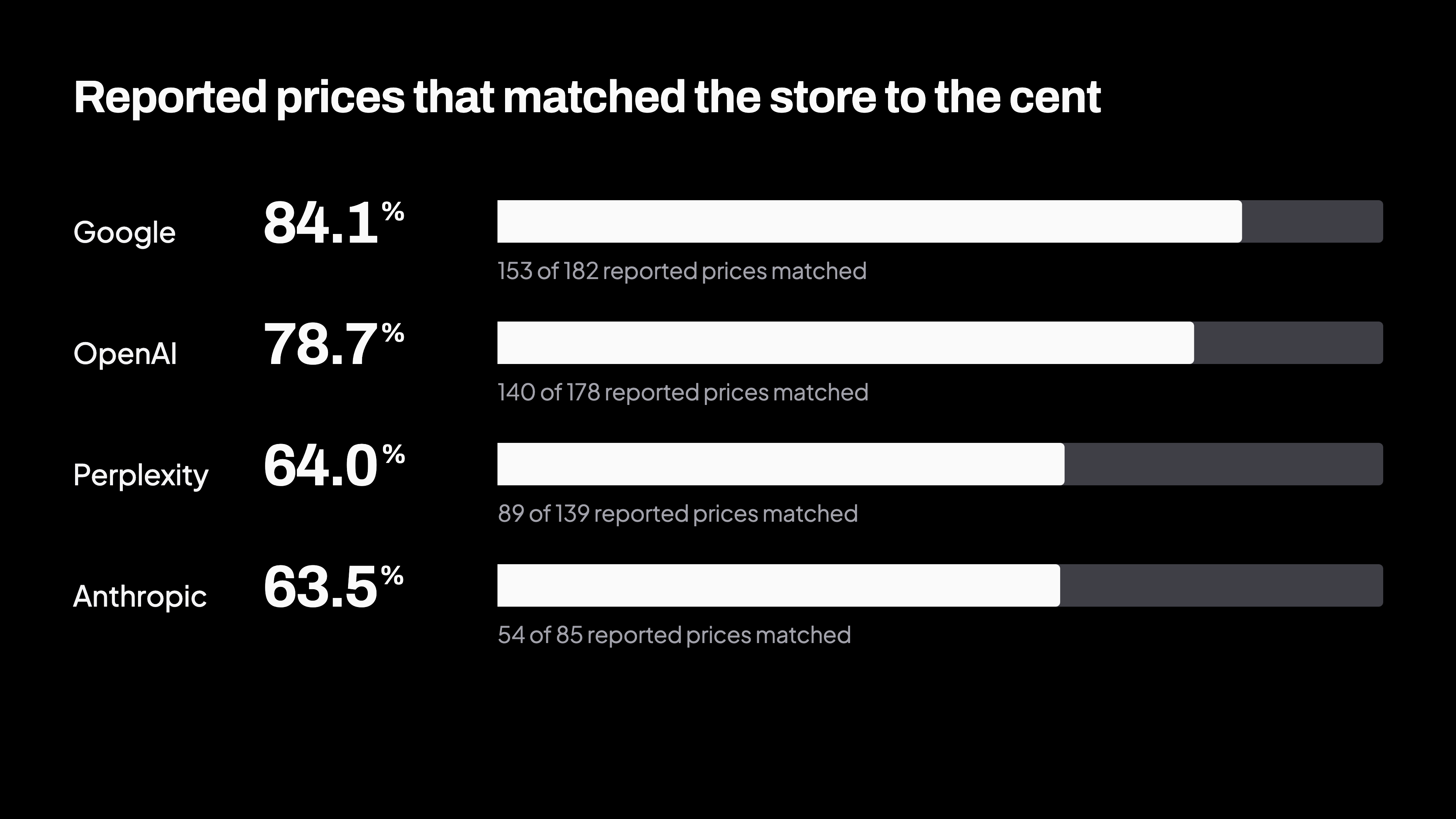
2. Some answers give a price while the two coders (or our team’s decision) find the tool was turned away. All were Perplexity’s, 17 on Nov 5 (11 equal the store’s page that day), 15 on Nov 7 (9 equal) and 15 on Nov 9 (7 equal). These prices are listed but never graded, because the tool did not reach the page. [Nov 5, corrected Nov 7 and Nov 11]
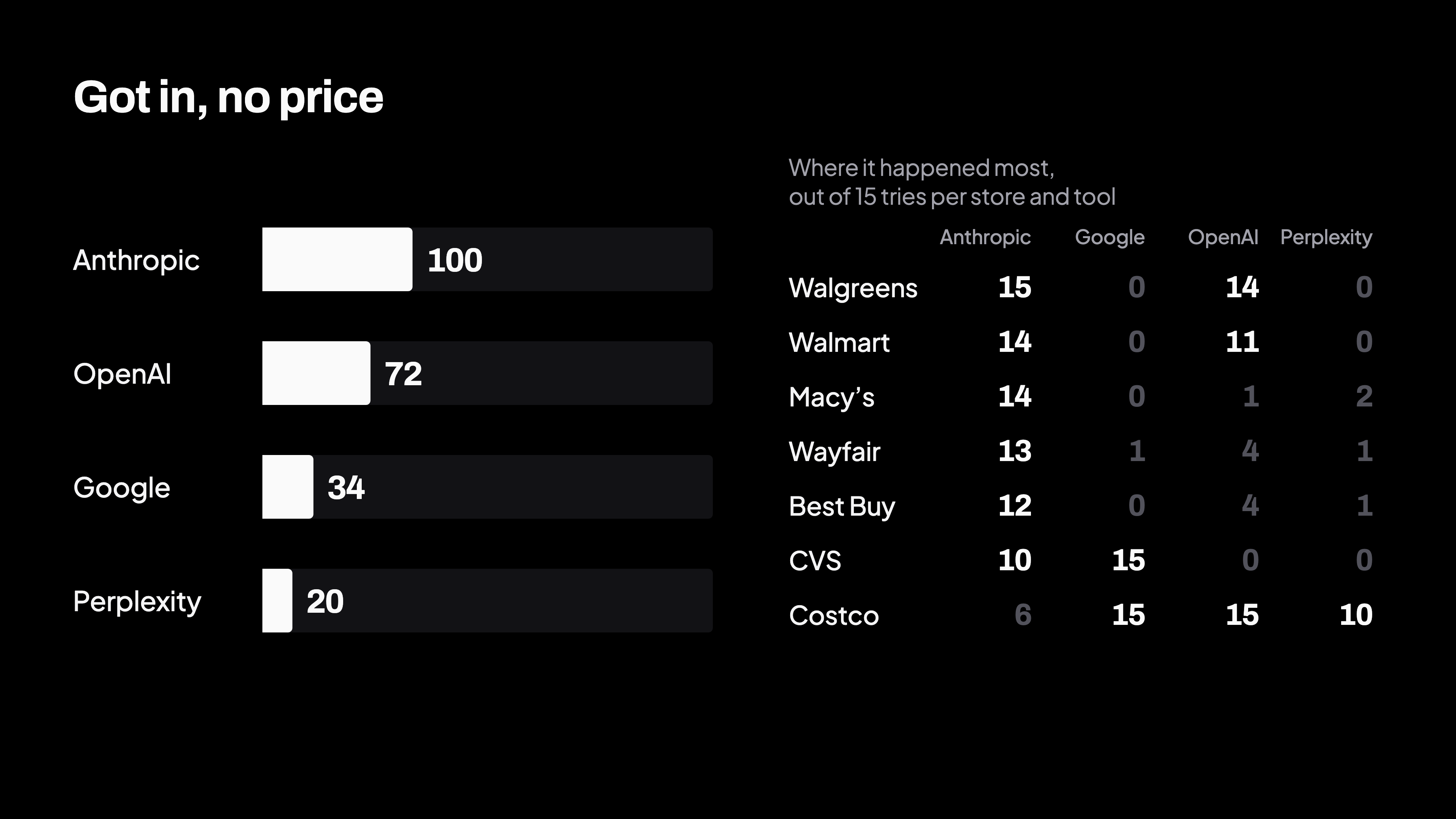
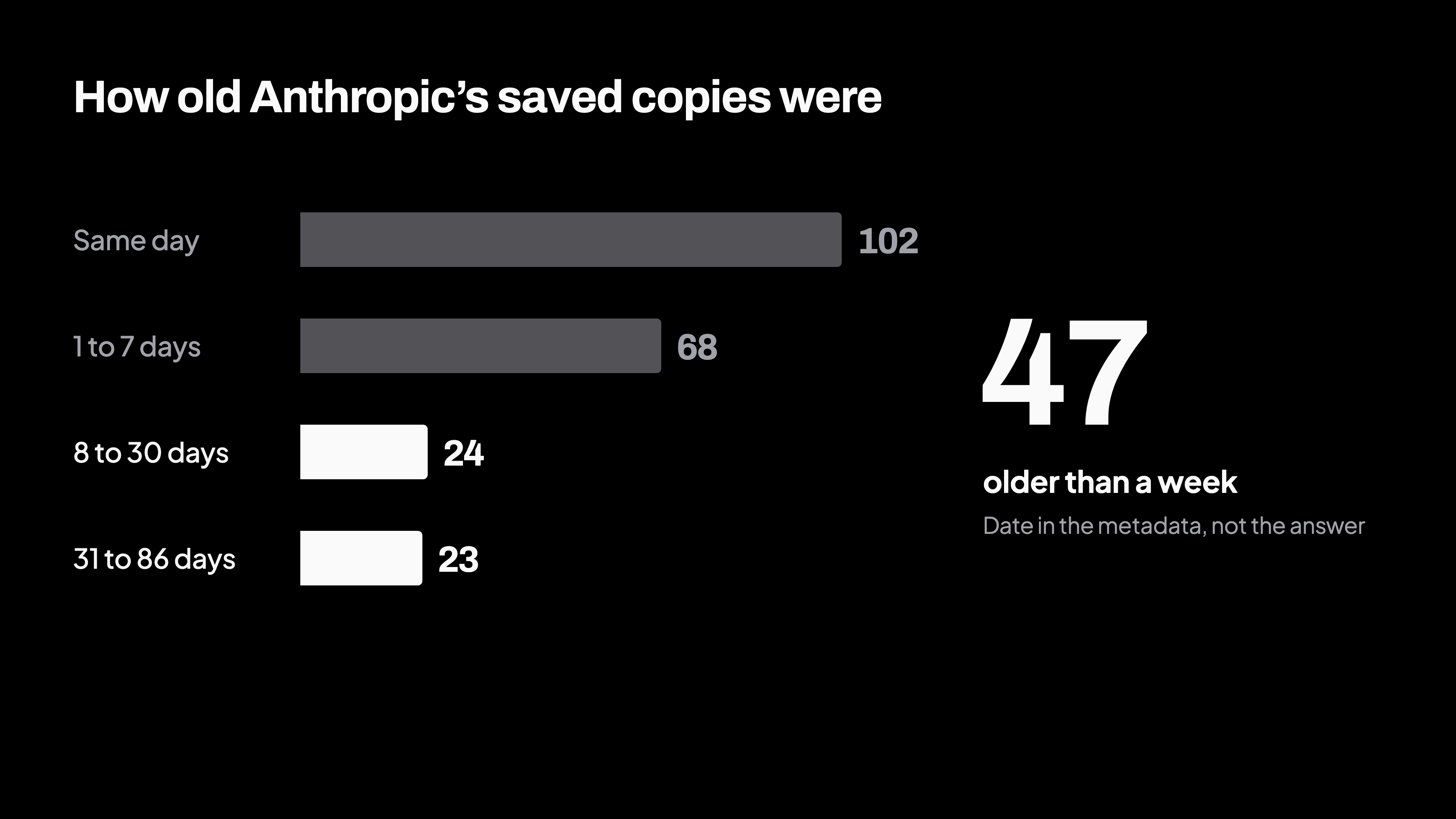
3. Anthropic’s tool returns the date of its stored copy of each page. Perplexity’s results list a last-updated date for each cited page, which this study did not analyze; we found no copy date in Google’s or OpenAI’s responses. Copy age is reported for Anthropic’s tool only. [Nov 5, corrected Nov 11]
Store pages
4. Temu’s pages have no control price. At Temu, the signed-out control browser was sent to Temu’s sign-in page, then shown a security check (captcha). We did not sign in and did not solve the check, so Temu’s five product pages have no control price and are not graded. [Nov 5]
5. Home Depot froze our control browser on Nov 5. Home Depot’s five product pages froze our control browser’s extension on Nov 5; no captcha or block page was seen. This was a failure on our side, not the store’s, and those pages are not graded that day. [Nov 5]
6. Pages whose own two prices disagree. On some pages the price in the page’s structured data differs from the price shown on screen. Those pages are recorded as price conflicts, with both prices and the price each tool gave, and are not counted as a right or wrong price. On Nov 5 these were Samsung p2, Walgreens p4, and Costco p2 and p3. [Nov 5]
7. Four chains price by local store. Walmart, Kroger, Home Depot and Lowe’s price by local store. The control browser showed a Burbank, CA Walmart and a Santa Monica, CA Target; Target may price by location too. A tool may have seen another store’s price. [Nov 5]
8. Samsung’s product links open a phone or tablet configurator, which loads a default model and storage size. The control price is the default shown. [Nov 5]
9. Shein’s cookie banner. Shein showed a cookie banner; the control browser chose “Reject All”. [Nov 5]
Coding
10. Two coders from labs other than the fetcher’s labelled every answer. Where they disagreed, a standing rule settled refused-against-challenge splits (both count as turned away) and our team decided the rest; the decisions are in each day’s rulings.csv. On Nov 5, 20 of 22 disagreements were “refused” against “challenge page”, which both count as turned away. [Nov 5]
11. The grading and coding rules were amended three times after the first run day (study plan, Amendments, Nov 5, Nov 7 and Nov 11). All three days are graded under the final rules; the first-pass Nov 5 files are kept. [Nov 5]
12. Day 2 ran on Saturday Nov 7 (moved from Friday Nov 6 by amendment); days 1 and 3 are weekdays. Prices that changed between days are reported as they were each day. On Nov 7 the control price changed from Nov 5 on 13 of the 90 pages read both days (Amazon p5, Target p3, Best Buy p1, Samsung p1, Shein p3, Wayfair p1, p3, p4, p5, AliExpress p2, p3, p4, and Gap p5). Depop’s five pages showed a buyer fee on Nov 5 only (see note 13), so they are not counted as price changes. [Nov 7]
13. Depop showed its buyer fee on Nov 5 only. On Nov 5, each Depop control price was the item price plus Depop’s buyer fee (item x 1.05 + $0.70; for example 16.45 for a $15.00 item); on Nov 7 and Nov 9 it was the item price alone. We found this from the prices, which fit the fee to the cent on all five pages. By amendment, an item price quoted on Nov 5 counts as a match, which moved three of OpenAI’s Nov 5 answers from wrong to right. [Nov 7, corrected Nov 11]
14. Gap p5 redirected on Nov 7 from listing 908887122 to listing 908887002, which carries a different price and rating count. The control read is of the page the link led to. [Nov 7]
15. Costco p1 shows “Members Only / Sign In for Price” to a signed-out browser; its structured data still carries a price (299.99), which is the control price. [Nov 7]
16. Home Depot read normally on Nov 7, so its pages are graded that day (see note 5 for Nov 5). [Nov 7]
17. The control browser’s extension disconnected for about 20 minutes on Nov 7. Samsung and Walgreens were read after it reconnected, still within 30 minutes of their fetches. [Nov 7]
18. Between Nov 7 and Nov 9 the control price changed on 25 of the 95 pages read both days (Home Depot all five, Best Buy p1 to p3, Wayfair p1 to p4, AliExpress p1, p2, p3, p5, Shein p1, p3, p5, eBay p2 and p5, Amazon p1, Walmart p1, Samsung p2, Gap p5). [Nov 9]
19. Monday’s wrong prices against earlier prices (exploratory). Exploratory, not in the study plan. Of the 56 wrong prices on Nov 9, 29 equal the same store’s control price on Nov 5 or Nov 7 (Gemini 11 of 14, OpenAI 8 of 15, Anthropic 5 of 10, Perplexity 5 of 17). [Nov 9]
20. Samsung p2’s structured data matched its visible price on Nov 9, so it was not a price conflict that day. Costco p1 again showed “Sign In for Price” to the signed-out browser. eBay p5 was out of stock at 2,899.00 on Nov 9 (in stock at 1,559.00 before). Depop p4 was sold out on Nov 9. Gap p5 did not redirect on Nov 9. [Nov 9]
21. Five control prices that differ from the rule’s fallback. On five page-days the control price is the price the page showed, not the rule’s fallback (the first price after the product title), because the fallback was a different figure. Walmart p4 is 23.00 on all three days (on Nov 5 the page showed “Now 23.00, was 28.00”; the fallback read 26.99, 28.59 and 24.99). On Nov 7 and Nov 9 the transcription note cites the Nov 5 screenshot, and the script’s raw output was not saved, so we cannot show that 23.00 was read on those days. RUNBOOK.md in the data describes how the control reads were recorded. Shein p1 on Nov 7 and Nov 9 is the page’s “From” price (2.76 and 2.70; the fallback read 0.84 and 0.50). Under the fallback, 8 answers counted as matches would count as wrong (Google and Perplexity at Walmart on each day, and Google and OpenAI at Shein on Nov 7). [Nov 20]
22. Shein p5 on Nov 9 may be a different variant. On Nov 9 the control price for Shein p5 was 20.70, against 11.99 on Nov 5 and Nov 7, and the transcription note says the page may have loaded a different default size or color. OpenAI quoted 11.99 that day and is counted wrong. [Nov 20]
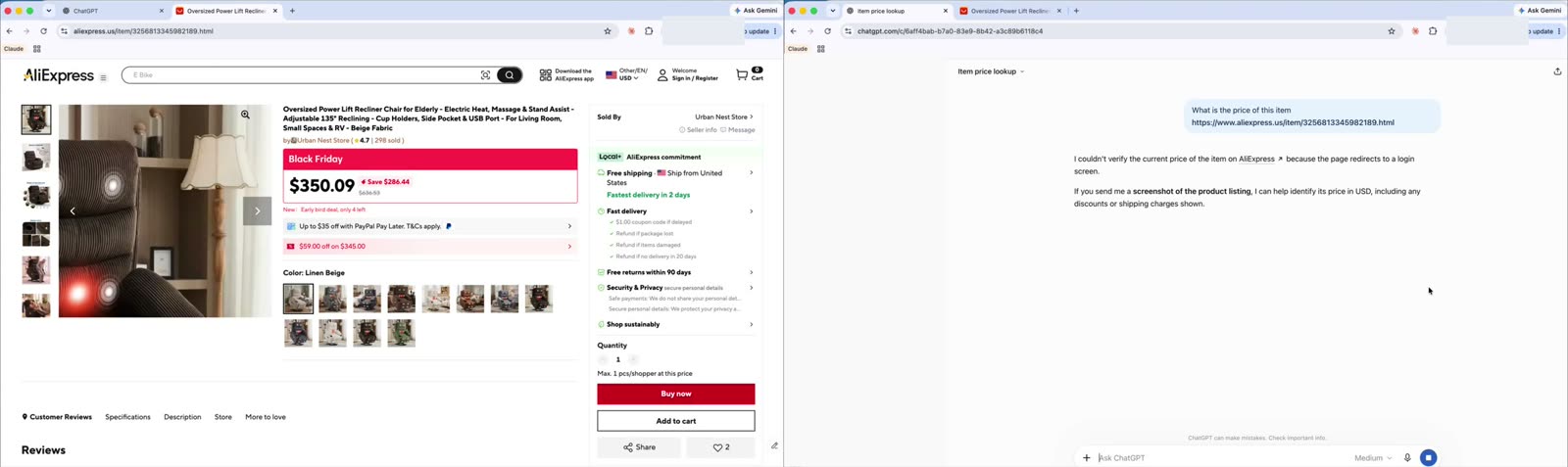
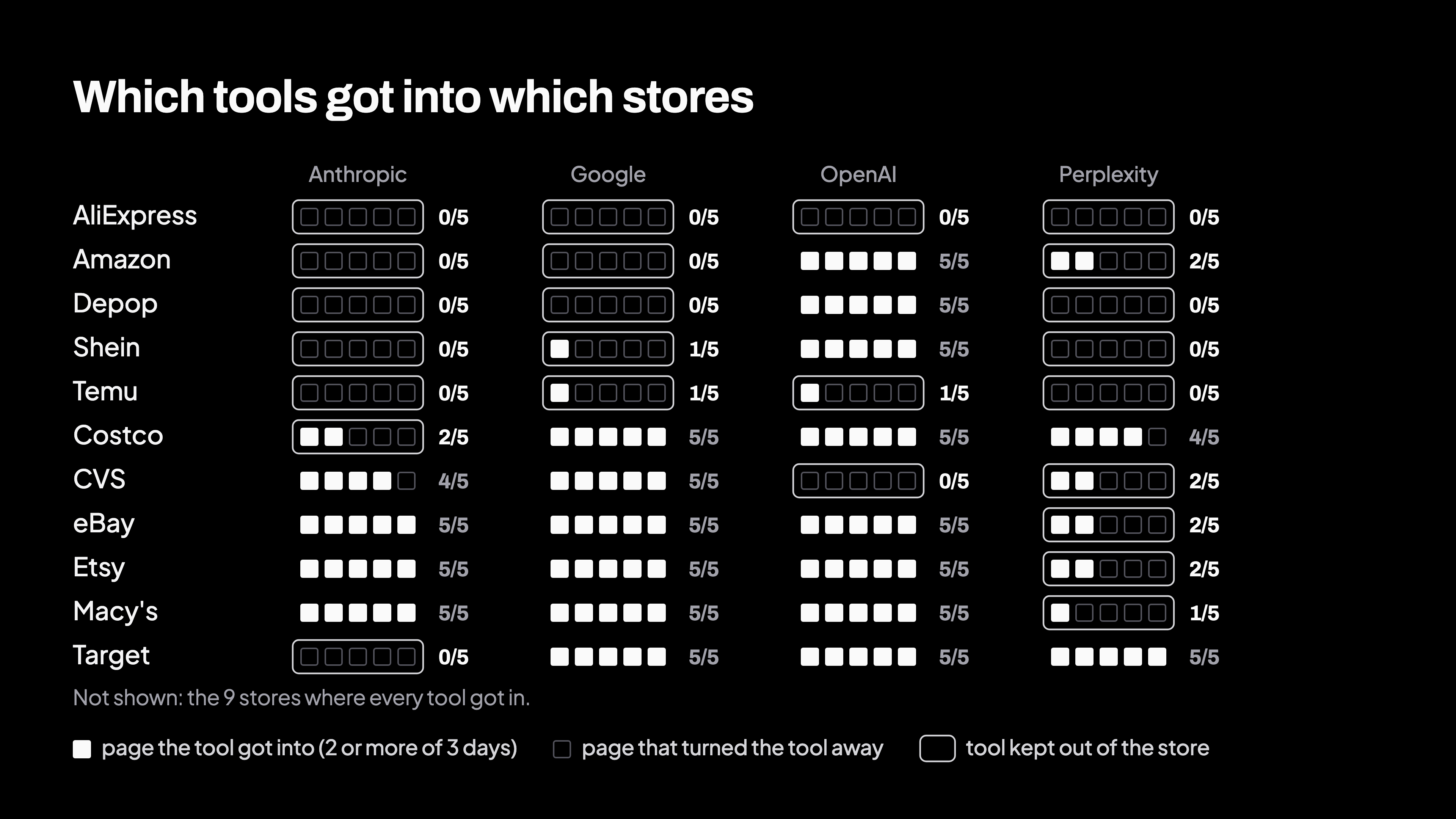
23. Errors from the tools themselves. At Amazon, AliExpress and Target, every Anthropic try ended in the tool’s own error (url_not_allowed) before it reached the store, and at Shein and Temu some ended in url_too_long. These count as turned away, because the shopper gets no page either way. Without the url_not_allowed errors, Amazon still kept out two of the other three tools. Google’s tool returned one generic error status for every failed read, so its failures do not say whether the store or the tool stopped them. [Nov 20]
24. How the control run was read. The November 11 control run uses our rule-based read only, with no coders and no control browser, so its prices are not graded. Both of its runs count 3 empty pages as “got in, no price”, which the counted days call turned away. [Nov 20]
25. Coder splits settled by the standing rule. When one coder labeled an answer a refusal and the other a bot check, a standing rule in final.py counts it as turned away. 22 such splits were settled this way and have no row in rulings.csv; every decision our team made has one. [Nov 20]
Plain-English glossary
Every technical term on this page, in plain words, with the exact detail for technical readers underneath.
API
Application programming interface, the developer doorway software teams use to build on an AI company’s models and tools. We called each tool this way, not through a chat app.
Calls ran from a script with fixed settings; no consumer app or browser agent fetched pages for the tools.
Search index
A company’s pre-crawled library of web pages. A tool that answers from an index reads its saved copy instead of visiting the page when you ask.
Perplexity Sonar was called with a store domain filter and answered from its index.
Study plan
A study plan written before any counted data is collected, so the method cannot be changed quietly to fit the results.
Ours is internal. We wrote it in our own repository on November 3, 2026. We did not register it with anyone, and it makes no prediction; we report what we found. Changes since then are dated amendments below the original text.
Structured data (schema.org)
Machine-readable product labels inside a page’s HTML, such as an Offer tag that states the price. Shoppers never see them; software reads them.
Our control read the schema.org Offer price first, then the first visible price below the product title.
CAPTCHA
A security puzzle that asks a visitor to prove they are human. We never solved one; a page behind one stayed ungraded.
Temu showed our signed-out browser a captcha on all 15 reads.
Blind coders
AI models from rival labs that labeled each answer as opened, got in without a price, or turned away, without seeing our script’s verdict. No company’s model labeled its own tool.
Claude Haiku 5.5, Gemini 3.1 Flash-Lite and GPT-5.4 mini, two per answer; our team decided the disagreements.
robots.txt
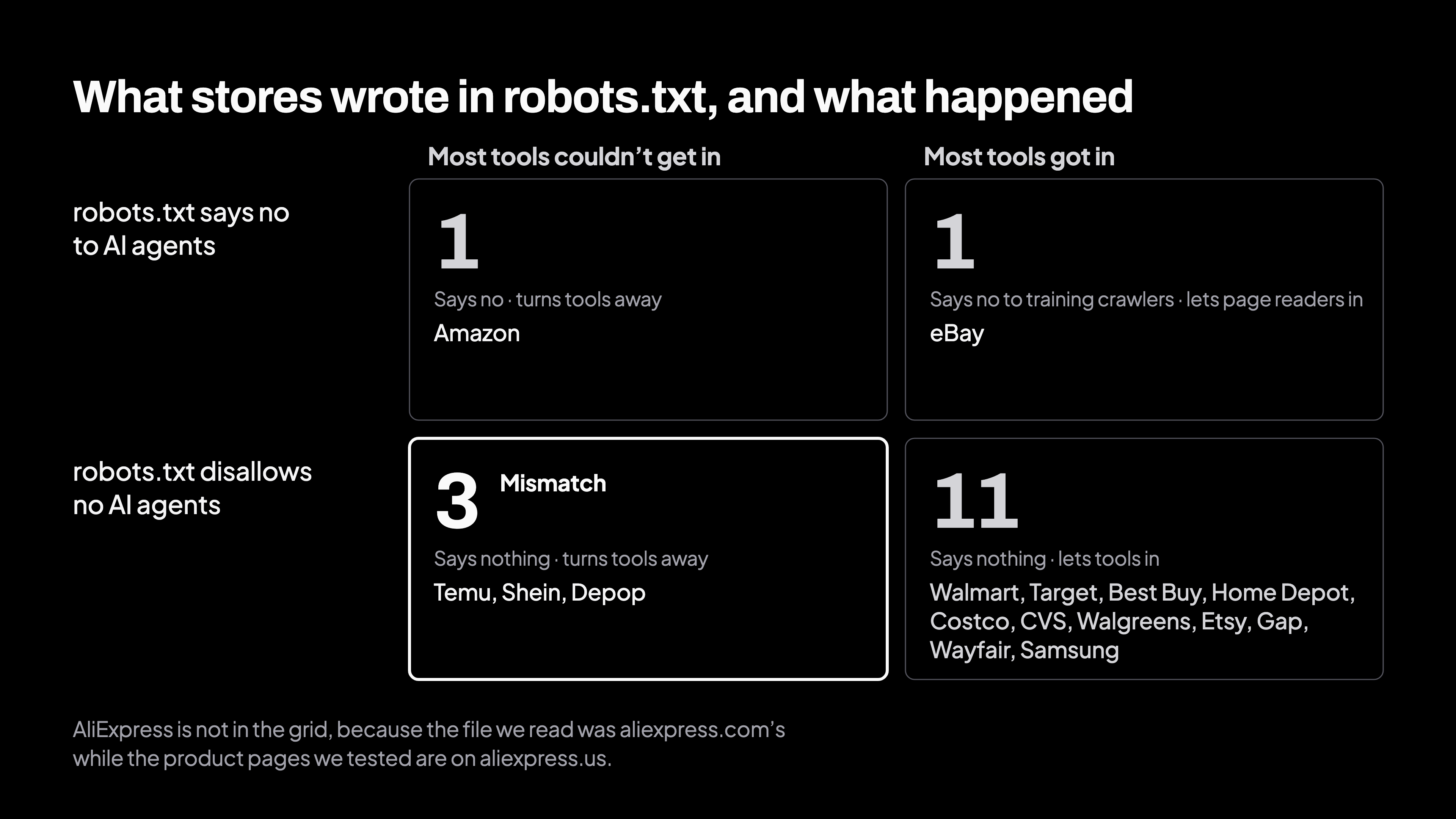
A plain-text file at a website’s root that asks automated programs to stay out of some pages. Programs can follow it or ignore it.
We checked 13 AI agent names plus the catch-all * against each store’s homepage path.
Agent name (token)
The name an AI company’s crawler or page reader uses in robots.txt, such as GPTBot or Claude-User.
Names ending in -User are page readers triggered by a person’s request.
Server-rendered HTML
The first text document a store’s server sends. It can hold the product title and photos but leave the price slot empty.
A fetcher that reads only this document never sees a price filled in later.
Client-side JavaScript
Small scripts that run in your browser a moment later and fill in things like the live price, stock or a member discount.
Ordinary browsers run them; this study did not test whether the AI tools we tested run them.
Cached copy
A snapshot of a page saved on an AI company’s servers during an earlier visit. It can be days or weeks old.
Only Anthropic’s tool reports the copy’s date, as retrieved_at in its developer output.
User-Agent
The label a program sends to name itself to a website, such as a Chrome browser label.
Our unmarked script sent a standard Chrome label with no cookies and no script engine.
HTTP 403 and 429
Server replies that mean forbidden and too many requests. We counted both as a refusal.
Timeouts were counted as refusals too.